
- SPI standards (A1 to D3) define mechanical polishing and blasting, whereas VDI 3400 (12 to 45) defines EDM spark-eroded textures: The VDI number follows the geometric progression formula
VDI = 20 · log₁₀(10 · Ra), where Ra is the arithmetic mean surface roughness in micrometers (µm). - SPI A1 to A3 optical mirror finishes (Ra 0.012 to 0.05 µm) require Electro-Slag Remelted (ESR) stainless tool steel: Standard P20 or 718H contains microscopic sulfide inclusions that cause orange-peel pitting during #1 (3 µm) diamond paste buffing. Always specify S136 ESR (48–52 HRC) or NAK80.
- VDI 24 to VDI 30 (Ra 1.60 to 3.15 µm) is the global industry standard for consumer and industrial electronic enclosures: It hides minor knit lines, fingerprint smudges, and subtle sink shadows while requiring only 1.5° to 2.5° of sidewall draft.
- Every 0.025 mm (25 µm) of texture etch depth requires an additional +1.0° to 1.5° of draft angle: Deep leather or coarse matte grains (VDI 36 to VDI 42, or Mold-Tech MT-11030+) will suffer severe ejection drag marks if sidewall draft is left at 1.0°.
- Always polish internal mold cores in the direction of ejection (SPI B1/B2 draw polish): Circumferential machine tool marks act as micro-undercuts that trap shrinking plastic and cause part sticking.


What Are the 12 SPI Surface Finish Classifications (A1 to D3)?
The Society of the Plastics Industry (SPI) surface finish system divides injection mold cavity finishes into four alphanumeric categories—SPI A (Diamond Buff Mirror), SPI B (Grit Paper Semi-Gloss), SPI C (Stone Matte), and SPI D (Abrasive Blast Textured)—spanning surface roughness values from Ra 0.012 µm up to Ra 18.0 µm under ISO 21920 surface texture metrology.
| SPI Grade | Finishing Method & Abrasive Media | Roughness Ra (µm) | Roughness Ra (µin) | Required Tool Steel | Typical Plastic Part Application |
|---|---|---|---|---|---|
| SPI A-1 | Grade #1 Diamond Buff (3 µm paste) | 0.012 to 0.025 µm | 0.5 to 1.0 µin | S136 ESR, 1.2083 ESR (50–52 HRC) | Optical lenses, light guides, medical cuvettes, transparent PMMA/PC windows |
| SPI A-2 | Grade #3 Diamond Buff (6 µm paste) | 0.025 to 0.050 µm | 1.0 to 2.0 µin | S136 ESR, NAK80 (40+ HRC) | High-gloss cosmetic consumer electronics, transparent visor covers, piano-black bezels |
| SPI A-3 | Grade #6 Diamond Buff (15 µm paste) | 0.050 to 0.10 µm | 2.0 to 4.0 µin | S136, NAK80, 718H | Clear industrial covers, glossy housings without strict optical refraction specs |
| SPI B-1 | #600 Grit Emery Cloth (Draw Polish) | 0.05 to 0.10 µm | 2.0 to 4.0 µin | 718H, S136, H13 | Semi-gloss technical housings; deep core pins requiring low-friction demolding |
| SPI B-2 | #400 Grit Emery Cloth | 0.10 to 0.15 µm | 4.0 to 6.0 µin | 718H, P20, H13 | Standard commercial semi-gloss parts, internal assembly brackets |
| SPI B-3 | #320 Grit Emery Cloth | 0.20 to 0.32 µm | 8.0 to 12.0 µin | P20, 718H | Non-cosmetic internal B-surfaces, structural ribs, and underside cores |
| SPI C-1 | #600 Aluminum Oxide Finishing Stone | 0.25 to 0.35 µm | 10 to 14 µin | P20, 718H, H13 | Fine satin matte appearance; removes EDM recast layer prior to B-series polish |
| SPI C-2 / C-3 | #400 / #320 Finishing Stone | 0.45 to 0.90 µm | 18 to 36 µin | P20, 718H | Functional industrial fittings, hidden chassis components, runner shut-off faces |
| SPI D-1 | Dry Glass Bead Blast (#11 Media) after #600 Stone | 0.80 to 1.20 µm | 32 to 48 µin | 718H, S136, H13 | Uniform non-directional satin matte finish for handheld instruments |
| SPI D-2 | Liquid Honing (#240 Oxide Media) after #400 Stone | 1.20 to 2.80 µm | 48 to 110 µin | 718H, S136, H13 | Medium dull matte texture; hides gate blush and subtle flow lines |
| SPI D-3 | Coarse Dry Oxide Blast (#24 Media) after #320 Stone | 3.20 to 18.0 µm | 125 to 700 µin | S136, H13 (Hardened for wear) | Heavy rugged industrial grip surfaces and high-friction mechanical housings |
How Does the VDI 3400 Texture Scale Convert to Ra Roughness and SPI Grades?
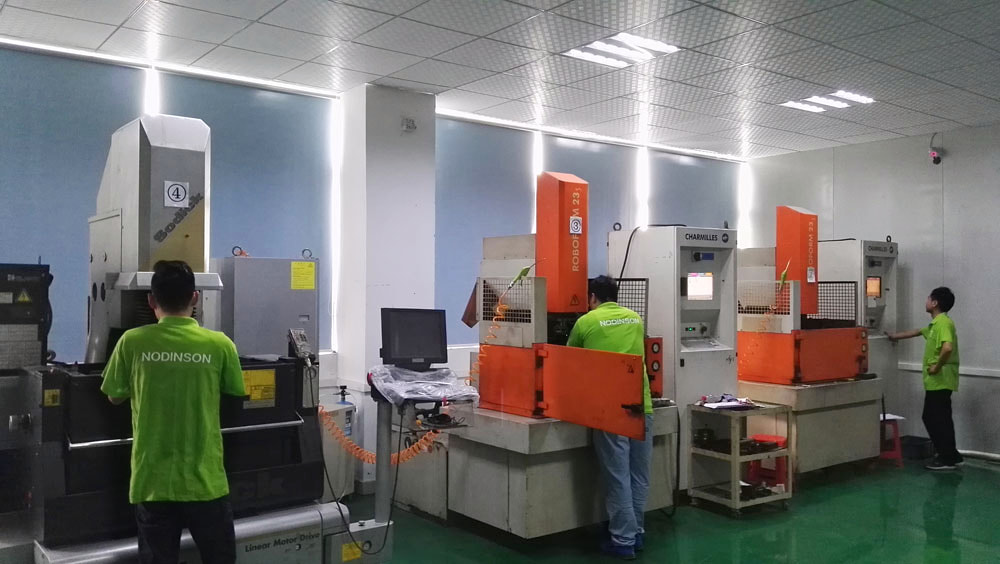
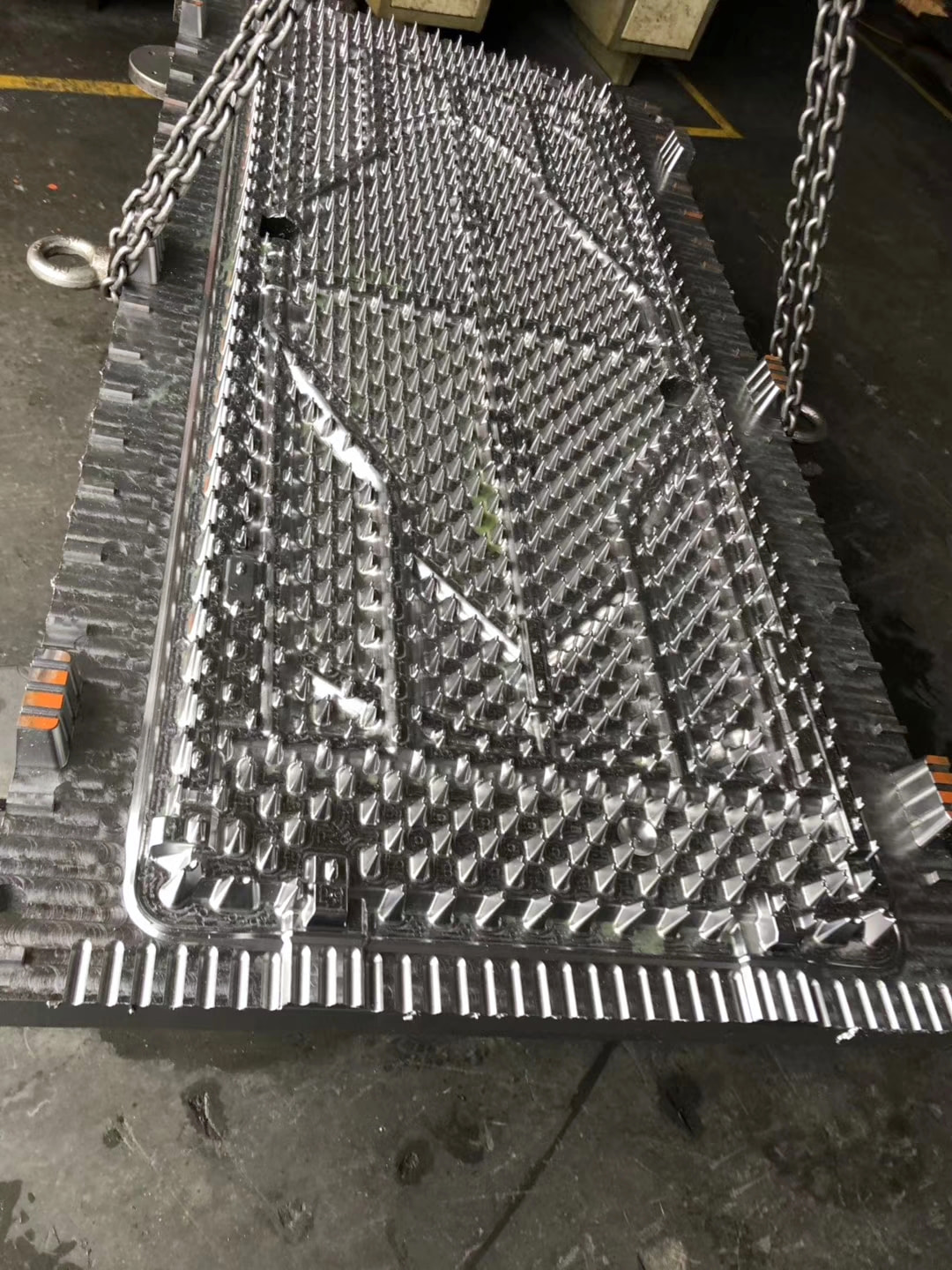
Defined by the Association of German Engineers (Verein Deutscher Ingenieure VDI 3400), the VDI texture scale specifies isotropic matte patterns generated directly by Electrical Discharge Machining (EDM) or acid chemical etching. Each VDI number corresponds mathematically to a target arithmetic roughness (Ra) via a logarithmic formula:
- Ra [µm] = Arithmetic mean deviation of the surface profile (For example, at VDI 30,
Ra = 0.1 × 10^1.5 = 3.16 µm) - Rz [µm] ≈ 4.5 to 5.5 × Ra = Average maximum peak-to-valley texture depth governing demolding undercut engagement
- θ_draft = 1.0° + (0.06° × Rz [µm]) = Practical minimum sidewall draft angle required for clean ejection without texture drag
| VDI 3400 Ref | Roughness Ra (µm) | Peak-to-Valley Depth Rz (µm) | Closest SPI Equivalent | Min. Sidewall Draft Angle | Visual Appearance & Typical Use Case |
|---|---|---|---|---|---|
| VDI 12 | 0.40 µm | ~1.8 µm | SPI C-1 / B-3 | 1.0° to 1.5° | Ultra-fine silky matte via Mirror EDM; small precision connectors & micro-parts |
| VDI 15 | 0.56 µm | ~2.5 µm | SPI C-2 | 1.2° to 1.5° | Very fine velvet matte; wearable electronics and medical instrument buttons |
| VDI 18 | 0.80 µm | ~3.6 µm | SPI C-3 / D-1 | 1.5° | Fine smooth satin; optical sensor housings (minimizes stray internal light reflection) |
| VDI 21 | 1.12 µm | ~5.0 µm | SPI D-1 | 1.5° to 2.0° | Clean modern electronics matte (laptop chargers, routers, desktop instruments) |
| VDI 24 | 1.60 µm | ~7.2 µm | SPI D-2 (Fine) | 2.0° | Most popular electronics texture; resists light scratches and hides subtle weld lines |
| VDI 27 | 2.24 µm | ~10.0 µm | SPI D-2 (Medium) | 2.0° to 2.5° | Standard industrial enclosure texture; distinct tactile grain for handheld analyzers |
| VDI 30 | 3.15 µm | ~14.0 µm | SPI D-2 / D-3 | 2.5° to 3.0° | Medium-coarse matte; automotive interior trim, power tool shells, rugged boxes |
| VDI 33 | 4.50 µm | ~20.0 µm | SPI D-3 (Medium) | 3.0° to 3.5° | Pronounced pebble grain; masks underlying rib shadows on glass-filled nylon parts |
| VDI 36 to 42 | 6.30 to 12.5 µm | 28.0 to 55.0 µm | SPI D-3 (Coarse) | 4.0° to 6.0°+ | Heavy anti-slip industrial texture; requires generous draft or side-action cavity release |
Upload your 3D CAD model. Our Shenzhen tooling engineers will verify your sidewall draft angles against your target VDI 3400, SPI, or Mold-Tech specification within 24 hours.
How Do Mirror EDM, Acid Chemical Etching (Mold-Tech), and 5-Axis Laser Texturing Compare?
While VDI 3400 spark erosion (EDM) is the most cost-effective way to apply a uniform isotropic matte finish directly during cavity machining, complex geometric grains—such as leather, carbon-fiber weave, woodgrain, or micro-geometric stipples (e.g., Mold-Tech MT-11010 to MT-11050)—require either photo-chemical acid etching or 5-axis femtosecond laser ablation.
If a mold cavity is scheduled for Mold-Tech chemical acid etching, the cavity block must be machined from a single, homogeneous forging (such as 718H, NAK80, or S136 ESR) and polished to at least SPI B-2 (#400 grit) prior to masking. Any TIG weld repair on the cavity face alters local carbon microstructure, causing the acid bath to etch at a different rate and leaving a permanent visible blemish on every molded plastic part!
Frequently Asked Questions on SPI Finishes & VDI 3400 Mold Texturing
Why does the same VDI 27 mold texture look glossier on PP or ABS than on PA66-GF30?
Plastic resin rheology and filler content strongly influence how faithfully the polymer replicates micro-cavities in the steel. Low-viscosity amorphous ABS at high mold temperatures reproduces 95%+ of the VDI micro-peaks, whereas 30% glass-filled nylon freezes rapidly and has stiff glass fibers bridging across micro-valleys, often shifting appearance until mold temperature is raised to 90°C–110°C.
Should internal mold cores be textured or polished?
Unless the inside of the part is a visible cosmetic surface, internal mold cores should always be finished to a smooth draw-polished SPI B-2 or C-1 grade in the direction of ejection. Texturing an internal core dramatically increases friction grip force as the plastic shrinks onto the core, requiring larger ejector pins and higher draft angles.
Can an SPI A-1 optical mirror finish cause parts to stick in the mold?
Yes! When molding soft elastomers (TPE, TPU, LSR) or flexible polyolefins against an ultra-smooth SPI A-1/A-2 surface, all air is squeezed out of the interface, creating a powerful vacuum suction seal. For non-optical flexible parts, specifying a fine matte finish (SPI D-1 or VDI 18–21) allows micro-air pockets to break vacuum adhesion during demolding.
What is the Mold-Tech equivalent to VDI 24 and VDI 27?
VDI 24 (Ra 1.60 µm, ~7 µm depth) is closely comparable in visual matte granularity to Mold-Tech MT-11010 (25 µm acid-etched stipple requiring 1.5°–2.0° draft), while VDI 27–30 (Ra 2.24–3.15 µm) serves similar industrial enclosure applications as MT-11020 (38 µm depth requiring 2.5°–3.0° draft).
Authoritative Standards & Engineering References
- VDI 3400 Guideline: Electrical Discharge Machining (EDM) Surface Roughness Reference Plaques (Verein Deutscher Ingenieure).
- Plastics Industry Association (SPI): SPI Mold Finish Guide (Categories A, B, C, and D).
- ISO 21920-2:2021: Geometrical Product Specifications (GPS) — Surface Texture: Profile Parameters (Ra, Rz).
- DIN EN ISO 4957: Tool Steels for Optical Polishing and Spark-Erosion Texturing.