
- Pre-hardened tool steels (P20 / 1.2311 at 28 to 32 HRC, 718H / 1.2738 at 33 to 38 HRC) eliminate post-machining heat treatment distortion. They are optimal for low-to-medium volume production (up to 500,000 shots) and large structural enclosure parts.
- Through-hardened martensitic stainless steel (S136 / 1.2083 ESR at 48 to 52 HRC) is required for abrasive glass-filled resins (PA66-GF30) and corrosive outgassing polymers (PVC, flame-retardant PC/ABS), achieving mirror optical polish (SPI A1, Ra < 0.025 µm).
- Precipitation-hardened NAK80 (37 to 43 HRC) delivers uniform hardness throughout thick core blocks, exceptional EDM machinability without surface micro-cracking, and zero requirement for subsequent stress-relief quenching.
- Hot-work tool steel (H13 / 1.2343 ESR at 48 to 52 HRC) provides maximum thermal fatigue resistance (heat checking) for high-cycle multi-cavity electronic tooling and metal insert molding applications.
- Always specify Electro-Slag Remelted (ESR) quality for Class 101 molds to eliminate microscopic non-metallic inclusions that cause pin-hole defects during diamond paste polishing.
How Do Mold Steel Mechanical Properties Dictate Tool Life?
Mold steel mechanical properties dictate tool life by directly governing resistance to abrasive resin wear, cyclic clamping fatigue, and corrosive chemical attack. Through-hardened steels (48 to 54 HRC) reliably withstand over 1,000,000 cycles for abrasive glass-filled polymers, whereas pre-hardened steels (28 to 38 HRC) typically deliver up to 500,000 cycles for unfilled commodity resins.
The Society of the Plastics Industry (SPI) classifies injection molds into five distinct service life tiers (Class 101 through Class 105). The choice of mold steel must directly align with production volume requirements, cycle speeds, and resin abrasiveness:
| SPI Class | Target Production Life | Recommended Core / Cavity Steel | Hardness Requirement | Typical Application |
|---|---|---|---|---|
| Class 101 | > 1,000,000 cycles | S136 ESR, H13 / 1.2343 ESR, 1.2344 | 48 to 54 HRC (Through-hardened) | High-speed automotive connectors, medical caps, thin-wall electronic housings |
| Class 102 | Up to 1,000,000 cycles | 718H, 1.2738, NAK80, 1.2316 | 34 to 42 HRC (Pre-hardened) | Industrial instrument bezels, consumer electronics, multi-cavity parts |
| Class 103 | Up to 500,000 cycles | P20 / 1.2311, 718, NAK55 | 28 to 34 HRC | Medium-volume appliance covers, internal brackets |
| Class 104 | Up to 100,000 cycles | P20, 1050 Carbon Steel | 24 to 28 HRC | Low-volume pilot production, non-abrasive PE/PP parts |
| Class 105 | < 500 cycles | Aluminium (7075-T6), S50C | < 20 HRC | Rapid prototype evaluation, investor validation units |
Investing in premium tool steel for Class 101/102 tooling amortizes rapidly. A premature parting line failure or slide galling on a P20 tool running glass-filled resin can halt a production line, costing thousands of dollars in unplanned downtime.
Which Steel Should You Choose: Comprehensive Property Comparison
The optimal mold steel selection balances core hardness, thermal conductivity, polishability, and material cost. Pre-hardened P20 and 718H offer economical dimensional stability for medium volumes; martensitic stainless S136 provides superior optical mirror polish and acid resistance; precipitation-hardened NAK80 delivers uniform hardness without heat treatment stress; and hot-work H13 provides maximum thermal fatigue resistance.
Below is Nodinson’s engineering comparison matrix evaluating the most widely used mold steels across hardness, thermal conductivity, polishability, and corrosion resistance:
| Alloy Grade | European / DIN Equiv. | Supply Condition | Hardness (HRC) | Thermal Cond. (W/m·K) | Max Polish Class | Corrosion Resistance |
|---|---|---|---|---|---|---|
| P20 | 1.2311 | Pre-hardened | 28 to 32 HRC | 29 | SPI B1 (600 Grit) | Poor (Requires plating) |
| 718H | 1.2738 HH | Pre-hardened | 33 to 38 HRC | 32 | SPI A2 (Diamond paste) | Low |
| NAK80 | Precipitation | Age-hardened | 37 to 43 HRC | 41 | SPI A2 / A1 | Moderate |
| S136 | 1.2083 ESR | Annealed $\to$ Hardened | 48 to 52 HRC | 20 | SPI A1 (Optical Mirror) | Excellent (High Cr) |
| H13 | 1.2344 / 1.2343 ESR | Annealed $\to$ Hardened | 46 to 50 HRC | 24 | SPI A2 | Low |
| 1.2316 | X38CrMo16 | Pre-hardened Stainless | 30 to 34 HRC | 21 | SPI B1 | High |
When designing thick-section boss cores or deep structural ribs, consider copper alloy inserts (such as MoldMAX® Beryllium Copper or Ampcoloy® with thermal conductivity ~130 W/m·K). While tool steel conducts heat at 20 to 32 W/m·K, strategically placed copper inserts pull localized heat away 4× faster, eliminating localized sink marks without slowing overall press cycle speed.
How Does Corrosion Resistance Prevent Tool Degradation?
Corrosion resistance prevents tool degradation by eliminating surface micro-pitting caused by volatile acidic gases (hydrobromic and hydrochloric acids) outgassed by flame-retardant resins (UL94 V-0 PC/ABS) and PVC. Steels with over 13% Chromium (such as S136 / 1.2083) form a self-healing passive chromium oxide (Cr₂O₃) layer, preventing cavity etching and preserving SPI A1 cosmetic finishes.
In electronic and instrument component manufacturing, fire safety regulations frequently mandate flame-retardant polymers (such as UL94 V-0 rated PC, PC/ABS, or PBT). During the injection molding process, flame retardant additives and PVC polymers outgas volatile acidic compounds (including trace halogen acids such as hydrobromic acid HBr and hydrochloric acid HCl).
When standard P20 or 718H tool steels encounter these acidic vapors, galvanic micro-pitting occurs on the cavity surface within hours. This micro-pitting destroys texture definition, causes part ejection sticking, and produces severe surface haze.
Always specify S136 or DIN 1.2083 with minimum 13.0% Chromium (Cr) content whenever running UL94 V-0 or medical polymers. Chromium forms a self-healing passive chromium oxide (Cr₂O₃) protective layer that resists acid vapor attack, eliminating the need for hard chrome electroplating that can chip or flake off delicate shut-off shutoff kiss edges.
Submit your 3D CAD (.step) and 2D drawing to our Shenzhen engineering team. We evaluate resin compatibility, target production volume, gate design, and recommend certified tool steels under bilateral NDA.
What Heat Treatment Sequence Prevents Micro-Cracking and Warpage?
The heat treatment sequence preventing micro-cracking and warpage in through-hardened steels consists of stress-relief annealing (600°C to 650°C), vacuum austenitizing (1020°C to 1040°C), high-pressure gas quenching (5 to 6 bar N₂), and triple tempering (200°C to 520°C). This cycle converts brittle retained austenite into tempered martensite while eliminating oxidation and dimensional distortion.
Through-hardened tool steels (such as S136 and H13) must undergo a rigorous, multi-stage vacuum heat treatment cycle to achieve their target mechanical properties without dimensional distortion:
- Stress-Relief Annealing (Rough Machining +0.5 mm envelope): Slowly heat to 600°C to 650°C, soak for 2 hours, and furnace cool. This relieves deep internal residual stresses induced by heavy CNC rough milling.
- Vacuum Austenitizing & Gas Quenching: Heat in a vacuum furnace (10⁻³ mbar) to 1020°C to 1040°C. High-pressure nitrogen gas quenching (5 to 6 bar) rapidly freezes the austenitic matrix into high-hardness martensite while avoiding surface oxidation and decarburization.
- Triple Tempering (200°C to 520°C): Perform three successive tempering cycles immediately following quenching. This converts brittle retained austenite into stable tempered martensite, relieving micro-stress and setting the final target hardness to 48 to 52 HRC.
- Cryogenic Sub-Zero Treatment (Optional for Optical Tooling): Cooling to -80°C between temperings reduces retained austenite to below 1%, ensuring absolute dimensional stability over millions of thermal cycles.
Electrical Discharge Machining (EDM) generates localized spark temperatures exceeding 10,000°C. This melts the steel surface, which is rapidly quenched by the dielectric fluid, leaving an untempered, brittle "white layer" (recast layer) saturated with micro-cracks. If not polished off with diamond paste or relieved via a 200°C de-embrittlement bake, cyclical injection pressures will propagate these micro-cracks into catastrophic tool failure.
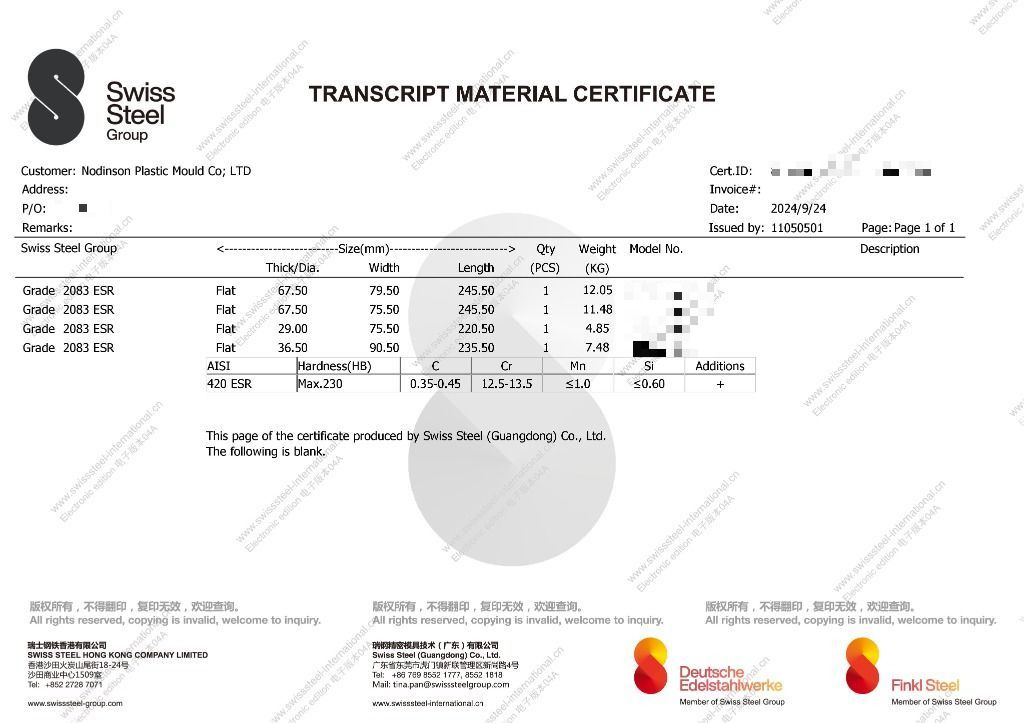
Verified Case: Swiss Steel 2083 ESR Vacuum Heat Treatment & Hardness Pass (49–50 HRC)
Every through-hardened tool manufactured by Nodinson is accompanied by authenticated Mill Test Certificates (MTC) and vacuum heat treatment inspection records. For high-precision production tooling (client project ID protected under NDA), double tempering at 515°C/500°C was verified by Swiss Steel with Rockwell hardness testing achieving 49–50 HRC.
Inspect Full Material Traceability Dossier on Quality Control Page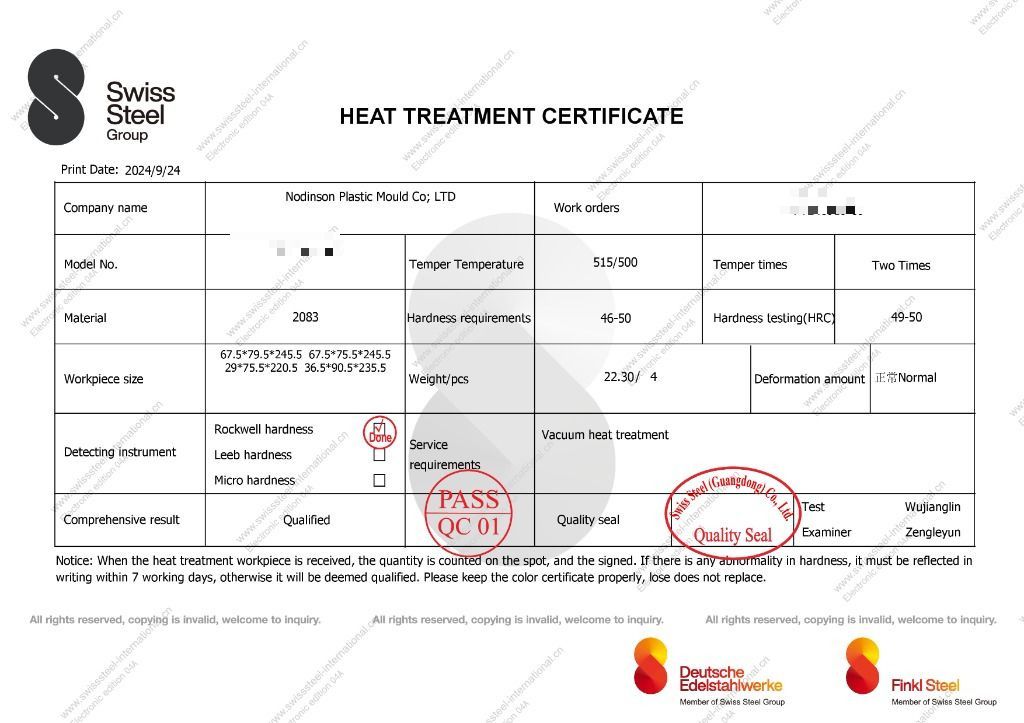
What Are the Polishability Limits and SPI Finish Classes?
Polishability limits in injection mold tooling are governed by steel microstructure, alloy purity, and carbide distribution. Electro-Slag Remelted (ESR) steels like S136 ESR are mandatory for SPI A1 optical mirror finishes (Ra 0.012 to 0.025 µm), whereas standard pre-hardened steels like P20 are restricted to SPI B1 paper finishes (Ra 0.10 to 0.20 µm) due to microscopic non-metallic inclusions.
Surface finishes on injection molded plastic parts are governed by the Plastics Industry Association (SPI) finish standards and VDI 3400 spark erosion texture grades:
| SPI Grade | Finishing Method | Roughness Ra (µm) | Minimum Steel Requirement | Optical Appearance |
|---|---|---|---|---|
| SPI A-1 | #3 Grade 3 µm Diamond Paste | 0.012 to 0.025 | S136 ESR / 1.2083 ESR (> 50 HRC) | Mirror high-gloss, optical lenses, light guides |
| SPI A-2 | #6 Grade 6 µm Diamond Paste | 0.025 to 0.050 | S136, NAK80, 718H | High-gloss cosmetic housings |
| SPI A-3 | #15 Grade 15 µm Diamond Paste | 0.050 to 0.100 | 718H, P20, NAK80 | Gloss finish with faint grain |
| SPI B-1 to B-3 | 600 to 320 Grit Paper | 0.100 to 0.250 | P20, 718H, 1.2311 | Semi-gloss, clean tool marks removed |
| SPI C-1 to C-3 | 600 to 320 Stone Polish | 0.250 to 0.700 | P20, 1050 | Matte, non-cosmetic interior structural ribs |
| VDI 3400 (12 to 36) | Electrical Discharge Texture | 0.400 to 6.300 | NAK80, 718H, S136 | Spark textured grip surfaces, anti-scratch |
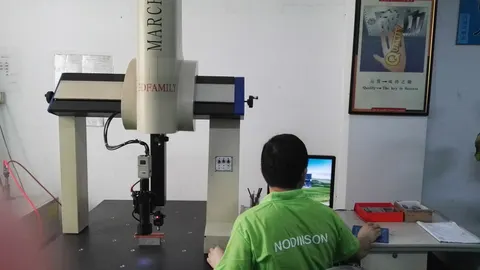
Counterfeit and reclaimed steels are prevalent in unauthorized supply chains. At Nodinson, every incoming mold block is inspected in Stage 01 IQC: we verify original Mill Test Certificates (MTC) from reputable mills (such as Uddeholm, Swiss Steel, Daido, or Fushun), perform ultrasonic non-destructive flaw testing (UT) for core voids, and conduct Rockwell hardness testing across multiple face coordinates.
Frequently Asked Questions on Mold Steel Selection
When should I choose S136 over 718H for an electronic housing?
Choose S136 if the plastic part requires an SPI A1 or A2 high-gloss cosmetic finish, if the resin contains flame retardants (such as UL94 V-0) or glass fibers, or if production volume exceeds 500,000 cycles. Choose 718H for standard ABS/PP commercial components where cost control and pre-hardened stability are prioritized.
Does higher hardness (HRC) always correlate with longer mold life?
Not necessarily. While higher hardness provides superior abrasive wear resistance, excessively hard steels (above 54 HRC) become brittle and vulnerable to impact cracking under cyclic injection pressures. Balancing core hardness with adequate fracture toughness (Charpy V-notch impact strength) is vital for long-term fatigue resistance.
Can NAK80 be modified or welded if design changes occur later?
Yes. Because NAK80 is an age-hardened precipitation alloy rather than a quenched carbon martensite, it exhibits superior weldability with specialized matching wire. Post-weld local re-aging at 500°C restores hardness uniformly without inducing brittle heat-affected zones (HAZ).
What is the difference between standard S136 and S136 ESR?
Electro-Slag Remelting (ESR) is a secondary refining process that remelts the steel ingot through an electrically heated conductive slag bath. This process eliminates non-metallic sulfur and oxygen inclusions, ensuring high microstructural purity and isotropic grain density required for flawless SPI A1 diamond optical polish.
Authoritative Standards & Metallurgy Sources
- DIN EN ISO 4957:2018: Tool Steels, Chemical Composition and Heat Treatment Guidelines.
- Plastics Industry Association (SPI): Standards and Practices of Plastics Moldmakers.
- ASM International Handbook Volume 1: Properties and Selection: Irons, Steels, and High-Performance Alloys.
- VDI 3400 Guideline: Spark Erosion Machining Surface Texture Standard (Verein Deutscher Ingenieure).